
'68 Mustang-Roadster
'68 Coupe to Fastback to.. Retro-futuristic supercar? A Questionable Journey
The marathon welding night
At 7pm on a Thursday, I thought I'd have maybe an hour before dark. Just a little tack welding on Fastback's inner structure, maybe get the quarter panels lined up, nothing mad. Nothing that would keep me in the tent past sunset. I had work the next morning. I'd be sensible about it.
By 2:30am, I was still there with a MIG torch in my hand, my back aching, my vision blurred from staring at molten metal, and absolutely no sense of how time worked anymore.
This is what the conversion looks like when you stop messing about and start permanently joining metal.
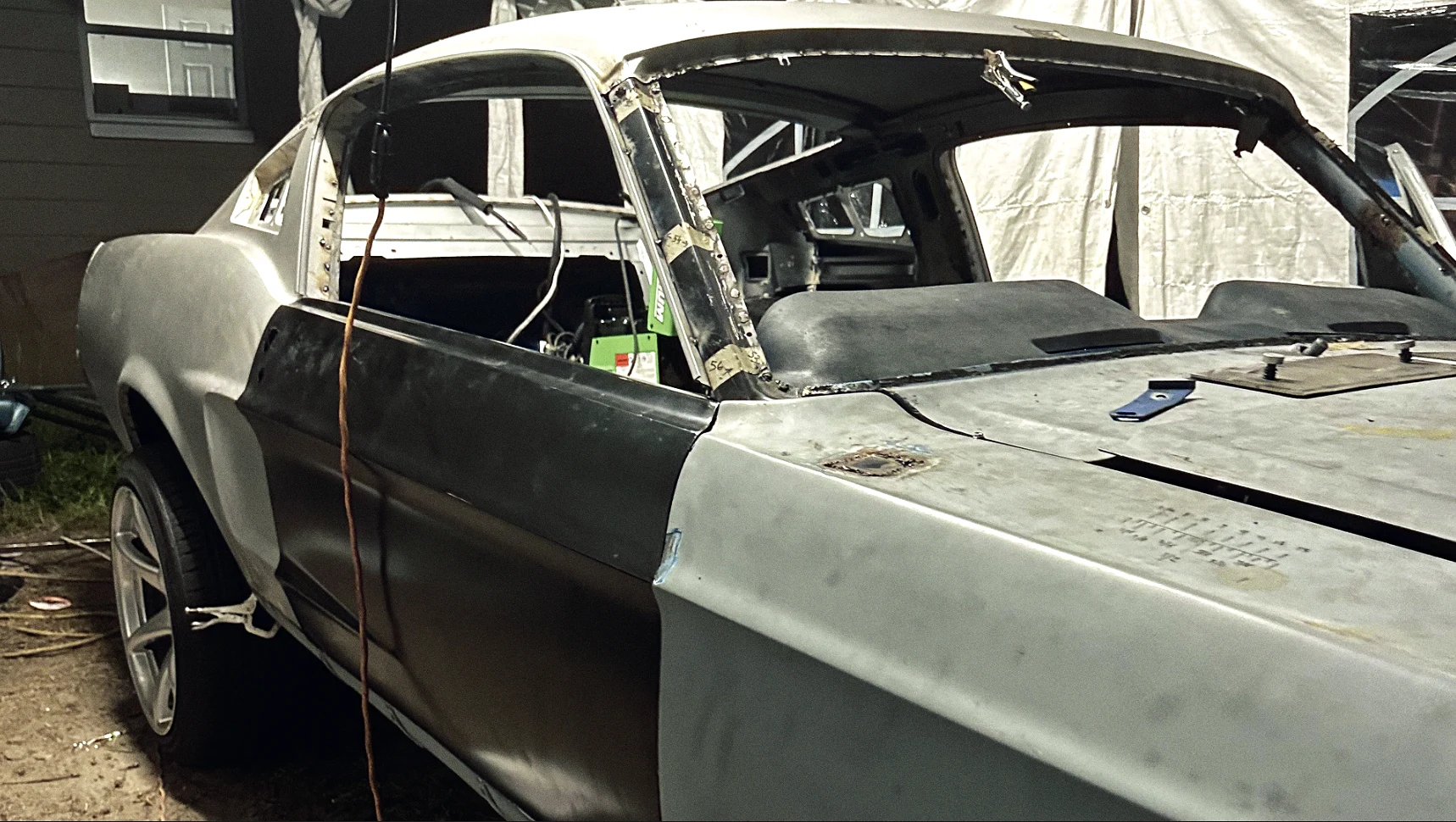
The week before had been all about precision. Trunk lid work, glass test-fit, measurement checks. Nothing flashy. Just the grinding detail work that separates a real conversion from a hack job. The trap door on the folding rear seat had been sitting too low, fouling the window frame by about 10mm. A minor thing, but in a conversion, minor things become major things if you ignore them. They compound. They undermine everything that comes after. So I adjusted it, measured it, checked the measurement again with a different tape measure just to be absolutely certain.
Everything fit.
Rear glass in place. Windshield where it should be, held by the new header we'd installed in the previous session. The body lines actually looked correct for the first time since I'd bought the half-converted Coupe six months ago. I stood back and stared at it for probably five minutes. This is the moment when you realise you're actually going to finish something. That the thing that looked impossible in week two is actually becoming real.
I remember thinking, "Right. Everything's aligned. Everything's measured. Everything's clamped. Now I weld it. After this, there's no going back."
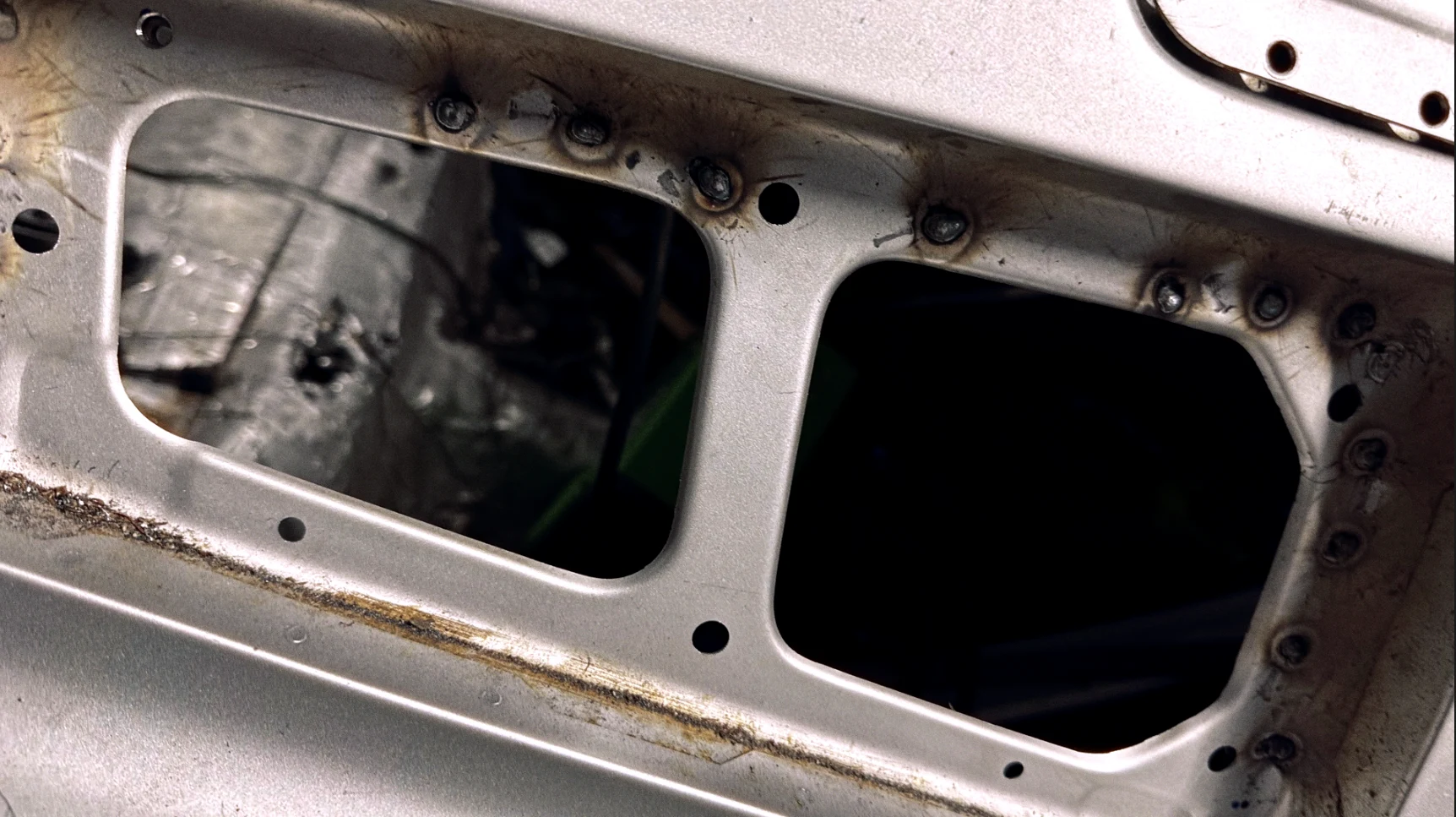
Marking parts for welding is its own kind of meditation. You punch centre holes where the bolts used to sit, mark the seams with a pen, check your measurements one last time. You know that once you strike the arc, there's no going back. Not without cutting the metal again. Not without destroying hours of alignment work. So you look twice, measure three times, touch the torch tip to the metal a fourth time just to be absolutely certain the angle is right, the gap is correct, the clamping pressure is even. By 6:45pm, I had Fastback positioned, clamped, and ready. The MIG welder was fuelled. I'd checked the settings three times. Voltage, wire feed, shielding gas, torch angle. Everything a textbook would recommend for mild steel at quarter-inch thickness. I wasn't taking chances here. The inner structure is what holds Fastback together. Botch this and you've got a car that flexes under acceleration, that twists at the waist, that will never feel right no matter how much paint you spray on it.
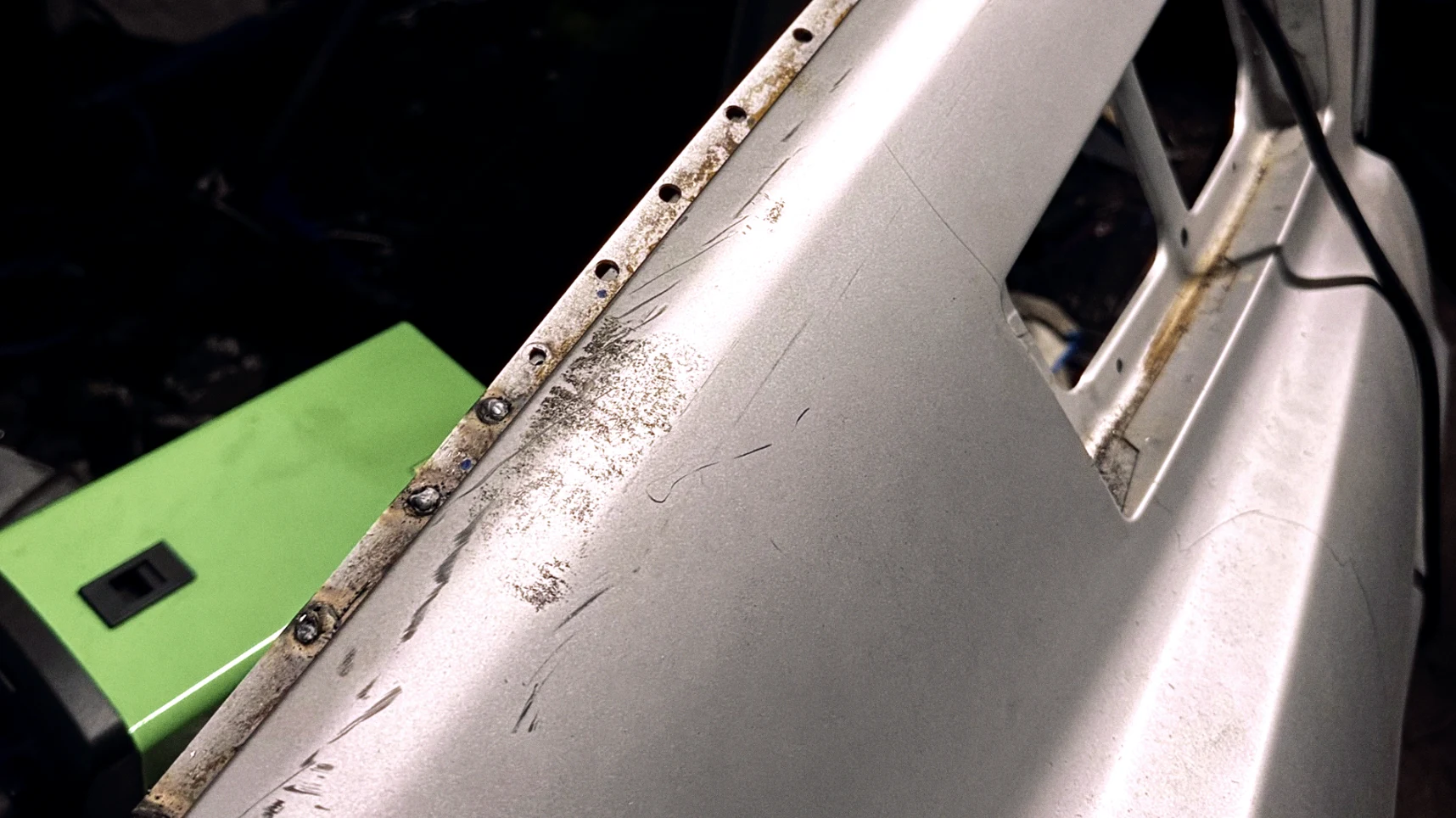
I struck the first bead at 7:05pm. Inner structure to the existing frame rails. Short tacks, half an inch long, let the metal cool between passes. Structural welding isn't about speed. It's about control. Every tack had to be perpendicular to the surface, had to pull the metal together without distortion, had to sit flush when you sanded it down later. The MIG gun felt light in my hands. Too light. Like it was going to betray me.
I ran the first pass. The metal fused. The joint held. It looked okay. Rough, but functional.
I moved to the next one.
Then the next one.
Then another.
Around 8:15pm, the tent had gone dark outside and I'd switched on the work lights. Two LED panels, 5000K colour temperature, bright enough to see the porosity in a weld from across the garage. I was maybe 20 percent through the inner structure. Quarter panels to go. Roof to go. Drip rails to go. And somewhere in the back of my head, a voice that sounded like my father saying, "You should be home by now."
I looked at the clock at 10:47pm.
Still at the inner structure. I'd done maybe 40 percent of what I'd planned. Maybe less. A normal person would have stopped here. A sensible person would have called it a night, gotten some sleep, come back fresh. I turned up the wire feed slightly and kept going.
The tent was silent except for the hiss of the MIG and the sound of metal cooling.
[Photo 11]
[Photo 12]
By 11:45pm, the inner structure was fully tack-welded. Core strength achieved. Every joint measured true. Everything was where it needed to be, held firmly in place by molten metal now solid, cooling and contracting back to strength. I sat back for maybe ten minutes, drank some coffee that had gone cold probably six hours ago, and realised my shoulders were absolutely destroyed.
Then I looked at the quarter panels, still sitting on their alignment jigs, waiting to be welded in place.
Quarter panels are the sides of the car, the biggest panels on a Fastback conversion. They're the structural difference between Coupe and Fastback. The reason the car will have an actual widebody look instead of looking like someone just glued a roof on. And they needed to be welded in, not bolted, not clamped. Permanently. No second chances. No taking it apart for adjustments. Once that metal was fused, Coupe was gone forever and Fastback was all that remained.
That's when the forum decided to remind me I might be doing this wrong.
I'd posted progress photos to VMF before I left for the tent, and by the time I was halfway through the session, Redneckgearhead had posted a comment: "You need a gas conversion on that welder. Slag in your critical welds is not ok."
Slag is the oxide buildup that comes off a stick electrode or a flux-core wire. It's supposed to get knocked off during cleanup, but if it gets trapped in the weld, if a pocket of it sits below the surface, you've got a weak joint. Catastrophically weak. The kind of failure that happens on the highway six months from now when the quarter panel suddenly separates from the body at speed. I looked at my welds on my phone. Some of them did have a little discolouration on the surface. Darkening. Maybe oxidation, maybe slag.
The comment landed like a physical punch.
He was right. Redneckgearhead was right. I shouldn't risk it. Not on quarter panels. Not on the structural conversion that would hold this car together.
So at 12:15am, I called Pete Schofield. He's a local welder, takes custom jobs, does restorations, knows what he's doing. The best part about calling someone at midnight is when they actually pick up.
"I'm in the middle of welding quarter panels on my Mustang conversion," I said. "And someone just pointed out I might be creating garbage welds with my current machine setup."
There was a pause. Then, "Where are you?"
Twenty minutes later, his truck pulled up to the tent. This is the thing about the real automotive community that actually works. When someone you've never met gets a midnight call about a car project, and they actually show up, it changes everything. No question about whether you're worth their time. No "come back during business hours." Just, where are you, I'll be there.
[Photo 13]
Pete pulled the MIG gun from my hand, looked at a few of my welds, and nodded. "These are fine," he said. "But they could be better. Let me adjust your machine." He walked over to the control panel like he'd worked on that exact welder a hundred times. Maybe he had. He dialled in the settings for the wire diameter I was using, the metal thickness I was joining, the recommended voltage for this job. "You were running a bit hot," he said. "See how the puddle's wider than it needs to be? All that extra heat you're putting in, you're wasting it. Heat rises. You're blowing it away instead of pushing it into the joint. Tighten it up. You want a narrow, deep puddle. That's where your strength comes from."
He showed me the technique on three spots on the quarter panel. Deliberate. Smooth. Pushing the torch slightly rather than pulling it, letting the heat go into the work instead of scorching the surface. "Feel the puddle," he said. "You're not just melting metal to fill a gap. You're controlling the flow. You're building strength." He ran a weld that looked like it came from a textbook. Consistent width, consistent height, perfectly symmetrical. No porosity. No gas pockets. Perfect fusion. The kind of weld that will hold at 150mph on a track.
Then he said, "God speed," put down the torch, walked inside the tent where I'd left a cooler sitting in the corner, made himself a mojito without asking, and sat down in a lawn chair to watch the work.
For the next three hours, I welded.
[Photo 14]
[Photo 15]
Everything he'd shown me suddenly made absolute sense. The tighter wire feed. The voltage adjustment. The torch angle. The speed. Each pass I ran came out better than the last one. Not perfect, not yet, but better. Controlled. Deliberate. The kind of weld you don't have to worry about in a structural car. The kind that will still be there in twenty years when I'm telling someone else's kid about the conversion.
Pete occasionally called out something from his lawn chair, "Tighter on that corner," or "You're going a bit cold there, push the heat in a little more," but mostly he just sat there, drinking mojitos at 1am in a party tent in Florida, watching some mad bastard permanently weld a Mustang Coupe back into Fastback. This is the unsung part of the automotive community. Not the Instagram posts or the YouTube channels. This is the part where a stranger shows up at midnight, fixes your work, and then supervises while you learn.
By 2:30am, the quarter panels were done. Both sides. Fully welded. Every seam from the rear door to the rear corner to the roof line was now one unified piece of fused metal. Fastback's entire side structure was structurally complete. I dropped my torch down on the work stand, looked at my hands, which were shaking slightly from fatigue and adrenaline, and realised I'd been welding for seven and a half hours without stopping.
No break.
No water.
No sense of anything but the next weld.
"How's that?" I asked Pete.
He got up from his chair, walked over, looked at the panels, ran his hand along a seam. "Thick and consistent," he said. "That car's never going back to being a Coupe. Not anymore."
That's the moment I dropped the hammer.
I didn't drop it on purpose. I was moving welding equipment, shifting things around the workspace to make room for the roof work, and my hand caught the edge of a heavy ball-peen hammer on the tool racking. Three pounds of steel. It fell maybe three feet. Straight down. And landed flat on Fastback's roof, right in the middle of the panel, just past the rear window line.
There was a sound like someone had smacked a bell.
And there was a dent.
Not massive. About 2 millimetres deep, maybe 2 inches by 2 inches in area. Barely noticeable unless you were looking for it with a straight edge. Easily fixed with a pin, a pull, and some bondo. A couple hours of work, tops. But it was there. After seven and a half hours of perfect welds, after all the precision and the technique and the supervision from someone who actually knew what he was doing, I'd just put a ding in the most visible part of the car.
I stared at it for maybe thirty seconds.
Pete made himself another mojito without comment.
"Happens," he said finally. "Could've been worse. Could've landed an inch to the left and you'd be straightening panels for the next month instead of just filling it."
He was right, which is the infuriating and reassuring thing about talking to people who actually know what they're doing. They've dropped hammers too. They've made mistakes. They've kept going anyway. So I made a note on my phone, photographed the dent for the forum record, and decided right then that I'd use a pin, a pull kit, and some bondo to fix it. Minor. Fixable. Not worth the drama of worrying about.
[Photo 16]
We brought the settings back up on the MIG and finished the roof welds. Not perfect, but solid. Controlled. The kind of work you can be proud of. Drip rails next, those small channels that run from the windshield back along the side of the body. The channels that guide water away. The channels that were now going to be permanently attached to Fastback's roof and side panels and inner structure, all one unified piece of welded metal.
By 3:15am, the drip rails were done. Fastback's roof and drip rails were now one piece with the inner structure and quarter panels. Every major structural component was welded together. The whole thing was way more stronger. Way stiffer. You could feel it when you pushed on the panels. There was no flex anymore. No give. The car was starting to actually be a car instead of a collection of metal sections held together with bolts and clamps and hope.
[Photo 17]
[Photo 18]
By 3:45am, Pete said goodnight, took the rest of the mojito cooler with him (the man had earned it), and drove home in the dark. I was supposed to stop. I had work in five hours. The sensible thing was to go home, sleep, come back fresh.
But I ran one more pass on every critical weld with a cleaner torch angle, the technique Pete had shown me. Nice, thick, consistent beads. Proper welds. The kind you don't second-guess when you're cruising down the highway at speed.
I finally stopped at 4:45am, cleaned the workspace, shut down the tent lights, loaded my tools, and drove home with the kind of exhaustion that feels exactly like achievement. The kind where you're shaking slightly and all you can think about is lying down, but part of you is already looking forward to tomorrow night's work.
The conversion was structurally complete. Coupe was gone. Fastback was welded.
[Photo 19]
[Photo 20]
[Photo 21]
Over the next week, I finished the remaining welds. Filler deck on the floor pan, the flat section that now connected the two quarter panels and the inner structure into one body. Roof reinforcements, internal bracing that wouldn't be visible but would make the structure significantly stiffer. Sealer welds at every critical joint. Everything that had been bolted or clamped through the entire conversion was now permanently fused. Structurally integrated. The structural conversion from Coupe to Fastback was complete. No more questions about whether the panels would stay. They were metal-bonded now. This wasn't a kit car anymore.
The top scoops arrived the day after we finished the core welding work. I couldn't be happier with them. Classy design. Clean lines. Functional air intakes for the engine bay that wouldn't arrive for another few weeks, but the scoops were ready and waiting. I dry-fitted them to the roof, checking alignment, checking fit, checking how they looked against the roof line. Perfect. They sat on Fastback's roof like they'd always belonged there, like they were part of the original factory design.
[Photo 27]
[Photo 28]
I did a first test with some body filler on a repair patch. Nothing structural, just to see how it worked with the new black epoxy primer I'd applied to the bare metal. The filler adhered perfectly. No lifting, no adhesion failure. Then I broke out the leather paint spray and tested it on a scrap panel. Black epoxy primer underneath, then black leather paint on top. Black on black. Something about that colour combination, the depth of it, the richness of it, the result was impressive. The paint had real depth. Real colour. This car was starting to actually become a car again instead of just a project sitting in a tent in the Florida humidity.
[Photo 29]
[Photo 30]
[Photo 31]
The future roadmap was suddenly clear in my head. Engine decision coming next, and that was going to be the biggest decision of the whole project. Ford 302 would be the boring choice. Safe. Reliable. Cheap. A proper 5.0 Coyote could work, give me reliability and decent power without drama or custom fabrication. Someone on the forum had suggested a V10 from an M5, which is the kind of absolutely insane idea that lives rent-free in my head now, even though it's completely mad and would require custom motor mounts and custom fuel systems and would probably cost more than I paid for the original Coupe. But imagine it. A 5.0 litre V10 screaming at 8,000rpm in a lightweight Fastback. That's the kind of absurdity that keeps you thinking about the car at 2am.
Visual mods after the engine, assuming I didn't go bankrupt sourcing a V10. Colour something in the grey family, maybe lighter than Nardo, maybe darker. I needed to think about it. Look at some colour samples in daylight. Check how they looked on the roof against the sky. And then moving, finally, to the new house garage. A real space with proper ceiling height and actual walls instead of a tent that moved in the wind. A workspace where I could work at 7pm and not have to worry about the weather or spiders or hurricane-force winds. The tent would rest in peace at last. It had earned it. Six months of rain and wind and cold starts. It had been a good tent.
[Photo 32]
[Photo 33]
The Coupe that I bought as a half-converted project, that I'd cut and clamped and measured and welded for six months, is now officially Fastback. Not in conversation anymore, not in theory anymore. Structurally, permanently, irreversibly. The conversion is welded. The real work is about to start. The finishing work. The work that turns a collection of metal and welds into an actual car.
One last thing before we move on to the next chapter. Could you guys propose a name for the car? She's earned it.
'68 Mustang-Roadster
'68 Coupe to Fastback to.. Retro-futuristic supercar? A Questionable Journey
'68 Mustang-Roadster
'68 Coupe to Fastback to.. Retro-futuristic supercar? A Questionable Journey
16 bölümOkumak için kaydır →