
Porsche 996, Piece by Piece
№1
The Line
The closer a project gets to the end, the slower you move. Not from being tired. You have simply lived inside it too long, and stopping is a parting. Not with the car, with the process. And with the people who come around and build it with you.
Film shows this best of all. Months of production, people working side by side every day, and toward the end of the shoot it begins: didn't we forget that shot, let's pick it up. The actors ask for one more scene, this improvisation, this little piece. The DP comes over: we really need this one move. Everyone brings something small, one little bit more. Over my years in film I understood: this is not a wish to stretch the process. People simply don't want to part with each other.
Same here. The exterior is coming to its end. The front is more or less addressed, the rear is not. Tonight we took it on.
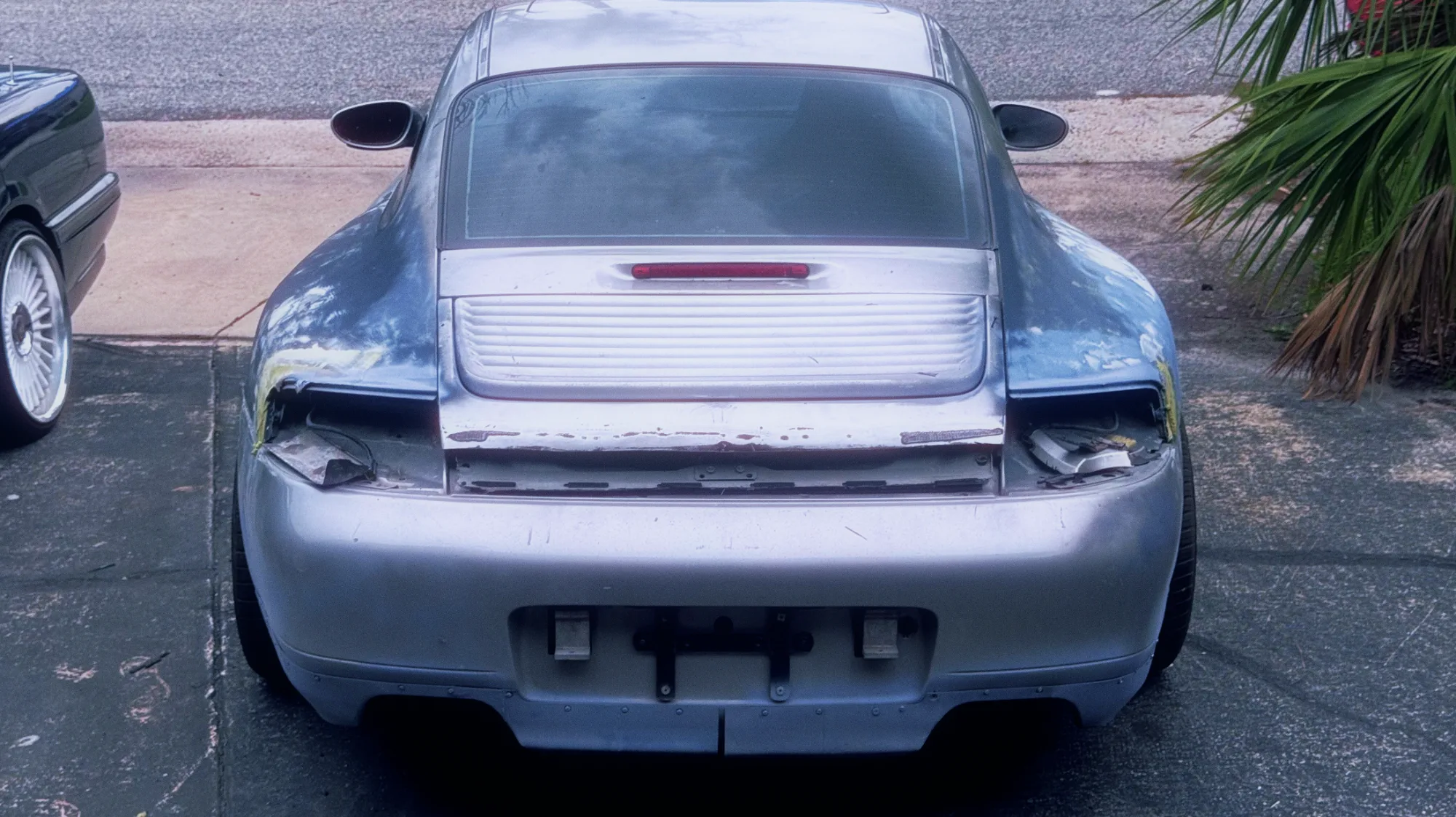
We printed the bumper overlay we designed recently, made for four pipes. It's a prototype, not a model for sale, so we didn't fuss: printed it, joined it into one piece, and set it on bolts, temporarily. Not bad. Printed the second half, measured everything out, ran 3M panel adhesive and bolted it all down for good. By morning it sat like it was cast in place. Time to wrap it in fiberglass.
The evening went to prep: cleaned the surface and drilled it full of holes. Whether that makes it stronger is a fair question, but from experience, when a large surface is turned into a colander, the fiberglass packs into the holes and truly hugs the panel. It holds noticeably tighter. I don't know if it's the ideal method, but for us it works.
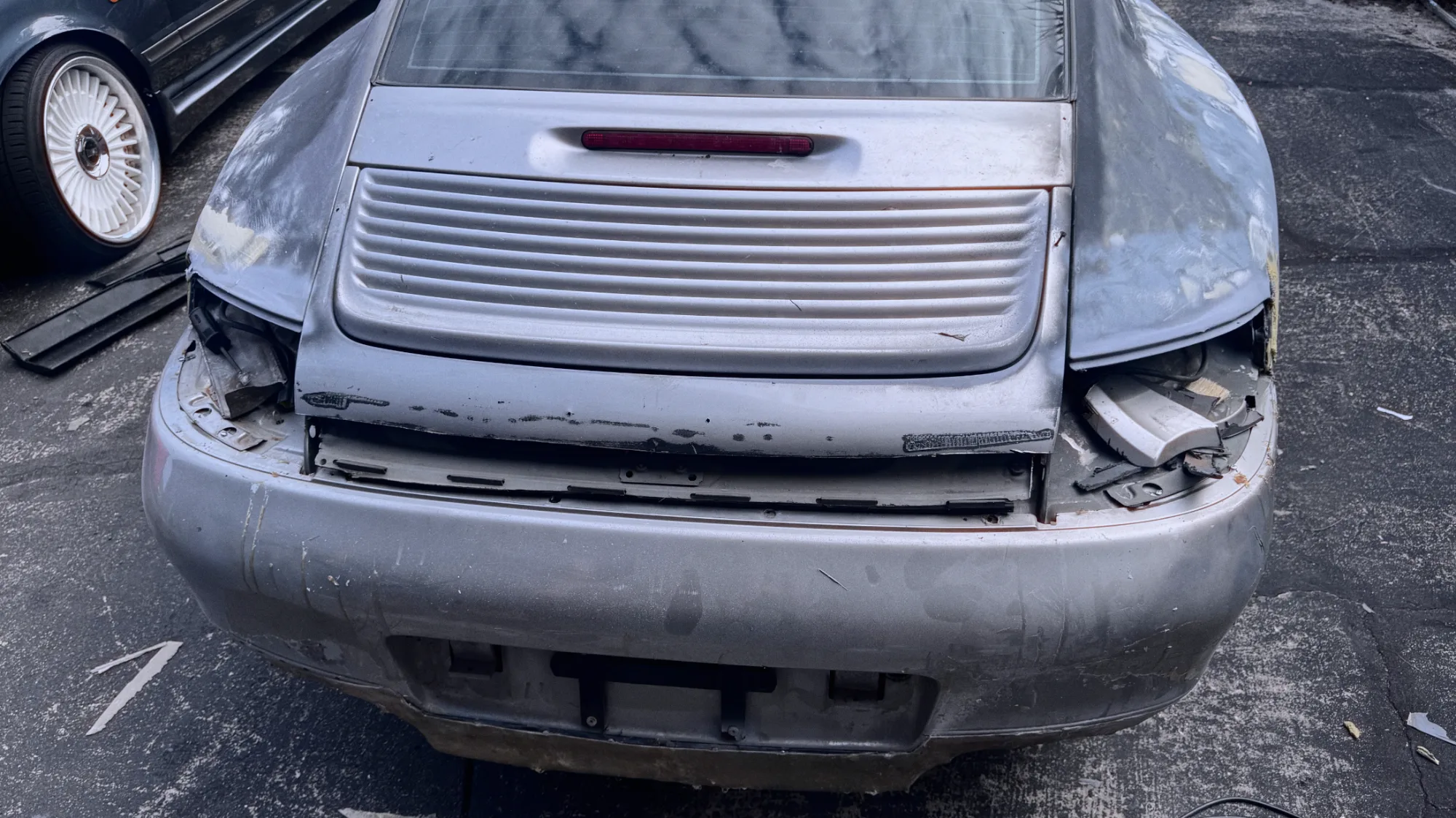
In the morning we poked it with a finger. Sits tight, if untidy. Which is understandable.
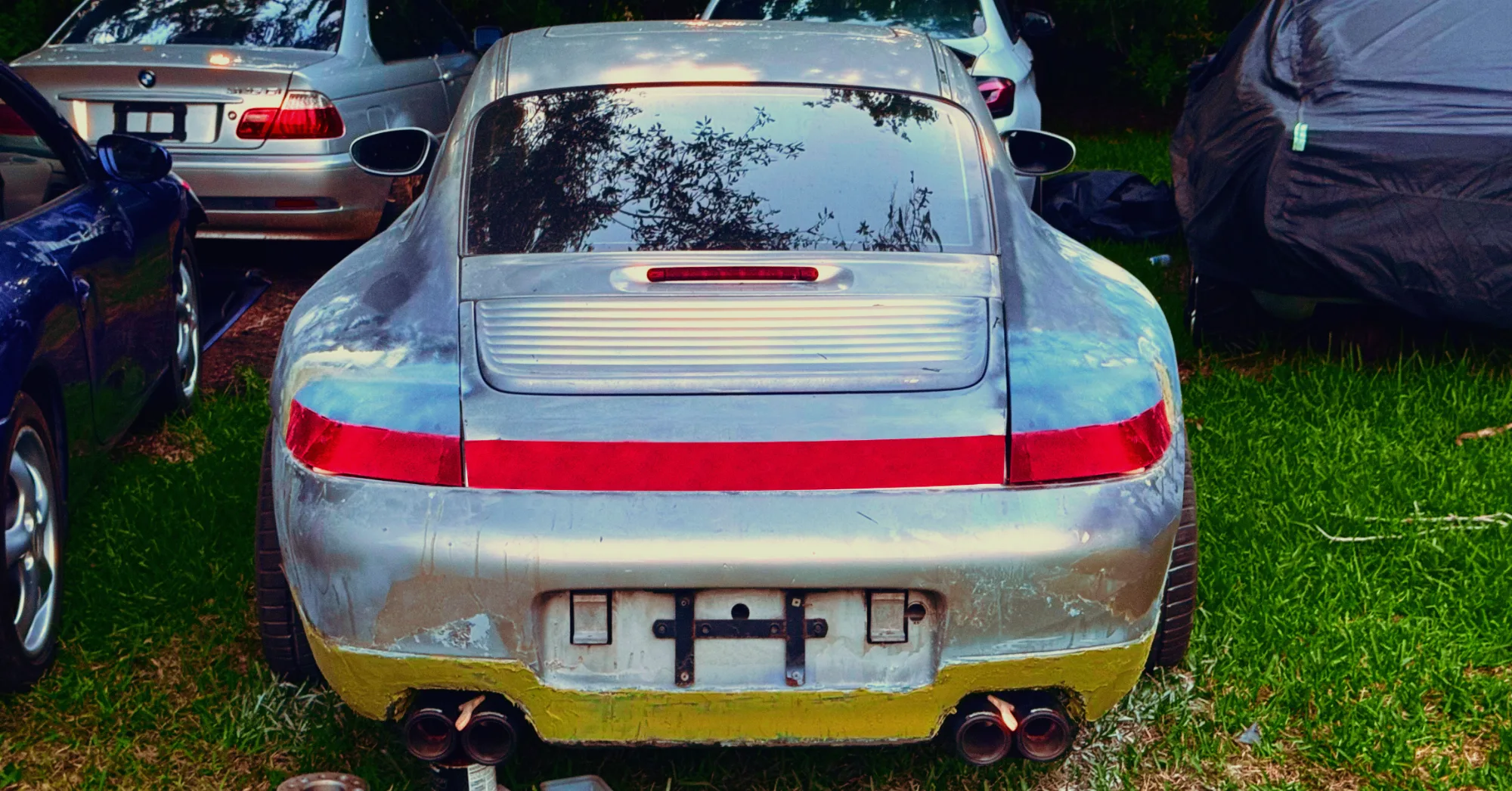
The main thing in this rear bumper is the line. A thin strip that runs its full length and splits it into an upper half and a lower one. It is not there by accident. The stock 996 bumper is fairly amorphous. Look at the lilac car, Carrera: the mass of the bumper is enormous, and the pipes are tiny. A huge rear end, and the exhausts are trinkets. Why the designer drew that line, I can't know. But it seems to me it cuts the bumper in two visually and lets the exhaust live its own life. Next to half the mass, the pipes no longer look so small. So keeping the line is critical for us. More than that, our line is stated harder than stock, than turbo, than C4S. Considerably more defined.
There is a reason. This car is wider than turbo, front and rear, and without the bulge that on turbo is justified by an intake. The widening is hidden by architectural moves that don't come up often in car design, and only a very experienced eye will read it as widebody.
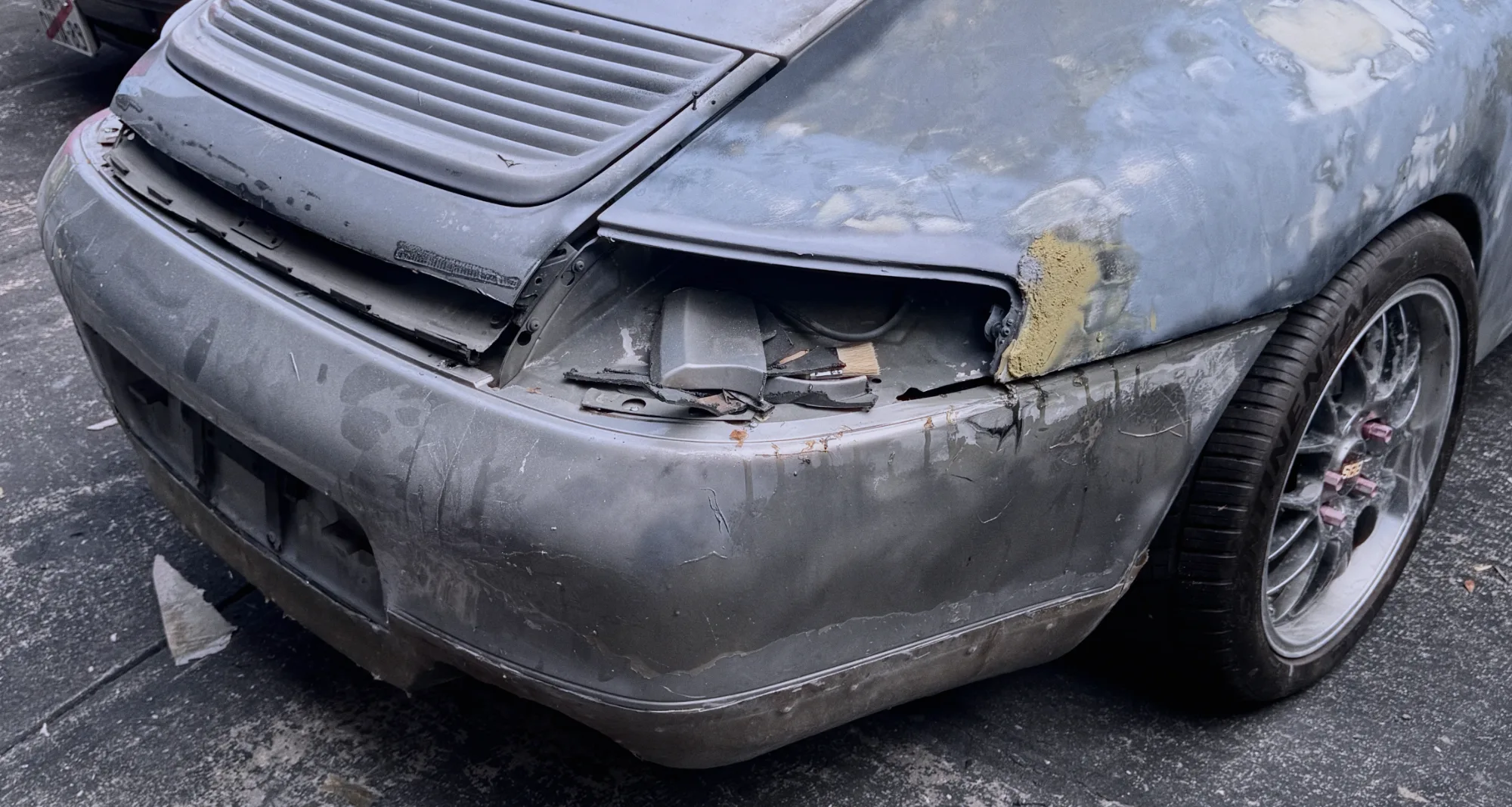
Then the line had to be restored: scraps of fiberglass had crept past it. We cleaned it off, sanded to a coarse 40 grit scratch, ran short strand fiberglass filler, let it sit an hour, sanded again, and covered it with ordinary filler. It could have been cleaner, but the area is small and this way it's fast. By the weekend the whole rear will be done.
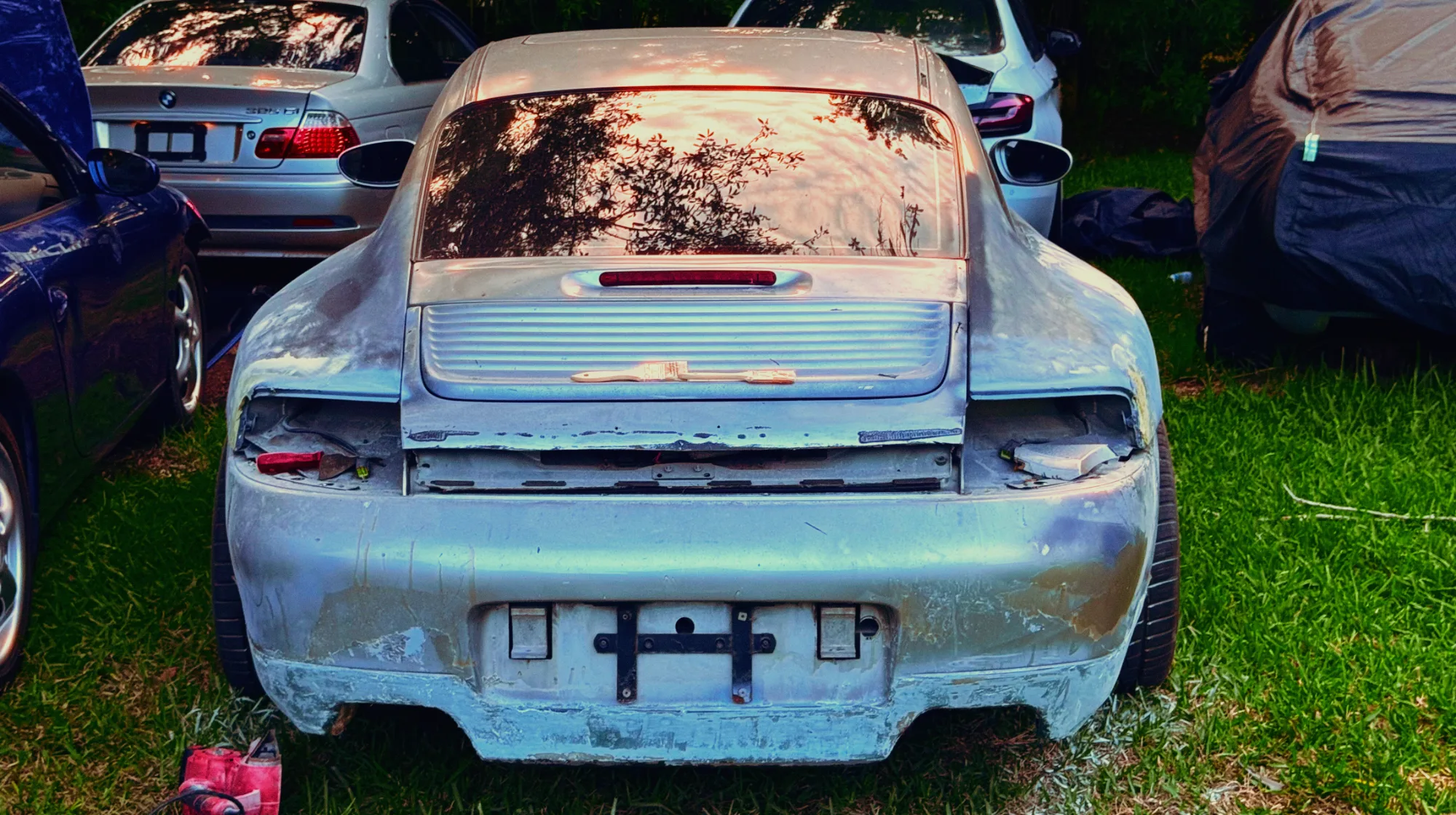
An important moment: the size and placement of the pipes. There will be four, and for reasons. Four pipes on Porsche is not a popular thing, and that gives me a pleasant footing to be different on one more level, beyond the forms themselves. Besides, a rear end this size needs considerably more expressive shapes. The widebody will most likely run two pipes, but absolutely massive ones. Here the design is subtler: four.
The hardest part in things like this is understanding how four pipes will sit on this particular car. There are 3D models, some you can look at on Mods Nation. But the main work is placement and rhythm: one pipe deeper, the next brought slightly out. And an exhaust should be looked at from a distance, not up close. So ninety-nine percent of the work is walking back and forth, not hanging tips on a pipe.
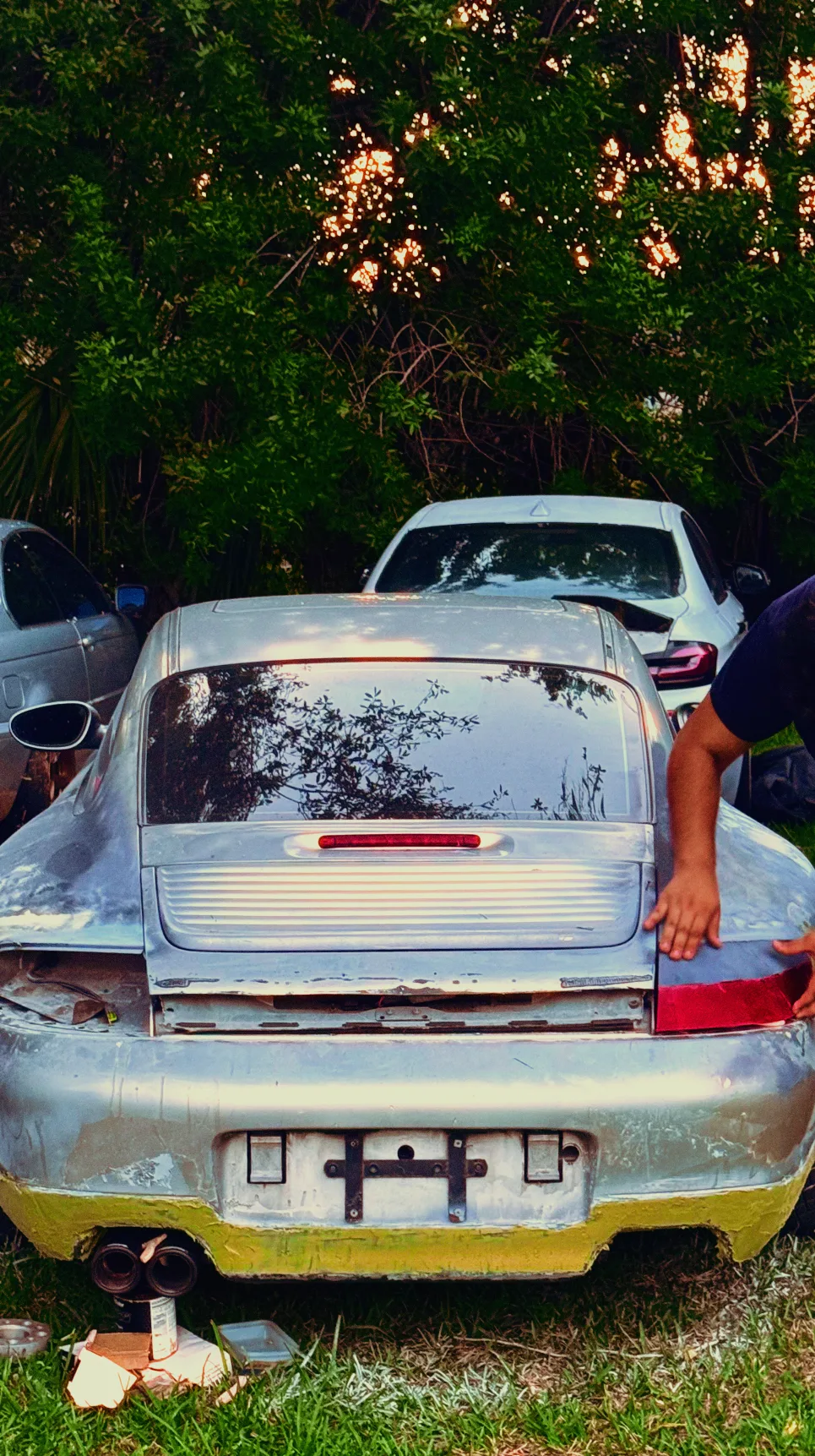
Felix and I set a pair of tips, and now we can move to the full rear panel. We'll print it and cast it in urethane in a silicone mold. There are a couple of innovations in there. I hope you'll like them.
For now, photos. And at the end, a photoshop sketch of the next step: all four pipes in place, and the red plastic running the full rear line for now, the shoulders carried out to the full length. The light comes later.
Porsche 996, Piece by Piece
№1
Porsche 996, Piece by Piece
№1
11 odcinkówPrzesuń, żeby czytać →