
'68 Mustang-Roadster
'68 Coupe to Fastback to.. Retro-futuristic supercar? A Questionable Journey
Five Fingers
Florida does not let you pause. It punishes you for it. The car sits under a cover, all above board, and outside it goes hot, then cold, then damp, then hot again, and the metal breathes along with it. You come back a month later, pull the cover off, and everything you had sanded smooth has moved along the seams. Marvellous. Sand it again, more or less from scratch. I suspect this whole year happens with a sanding block in my hand, whichever build we're talking about.
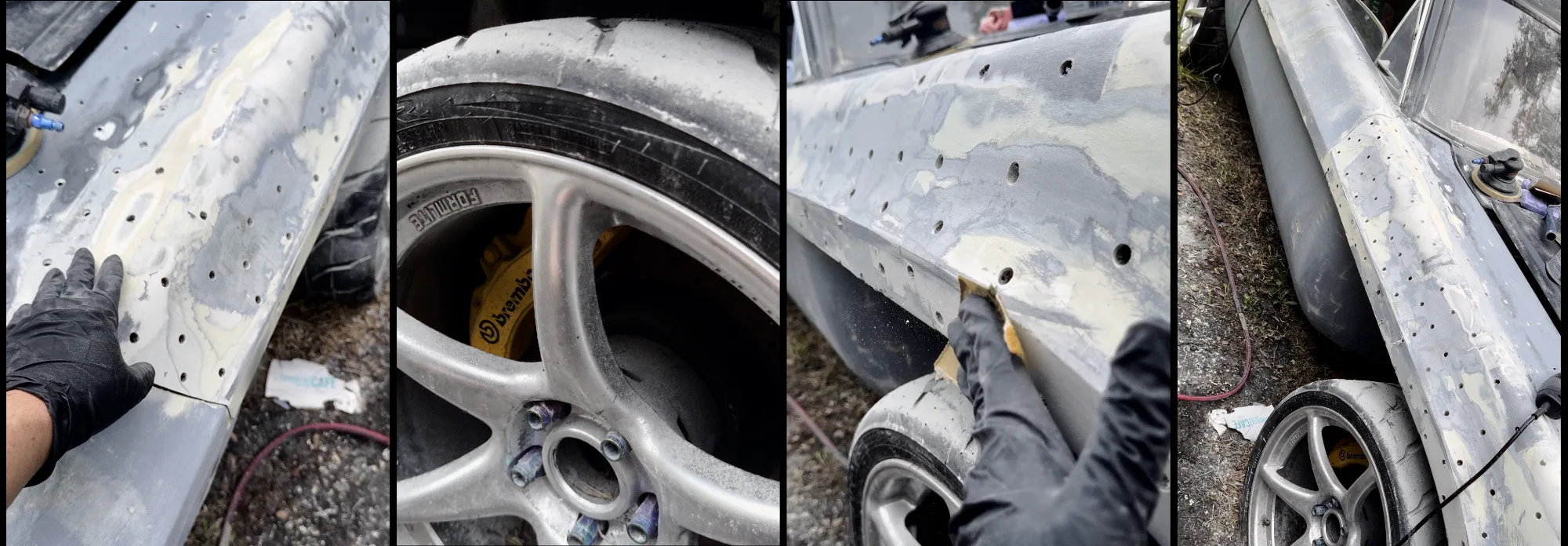
Felix doesn't actually have to turn up. He only has to text that he might, and something flips inside me: I walk out to the back yard and start cutting into Mustang. It's an idiotic mechanism and it has never once failed, so I've stopped arguing with it. Two hours of ignition out of nothing, every evening, a little at a time.
Moulds are needed only for doors, because doors have to open. Everything else can be wrapped in glass fibre in place. The structure is strong, it isn't going anywhere. Porsche was done the same way, and I've driven her on track, and so far nothing has come off anything.
While Felix was doing laps around town, I mixed epoxy. A small batch. I used to mix a big one and then chase it across the panel, losing. Now I mix exactly what I can lay down.
That's where everything changed. The plan isn't to do the car, the plan is to do half a panel. Top today, bottom tomorrow. It sounds like surrender, and in fact it's the only way to see what you're doing: at speed a panel is worked blind, and you find out a week later at the filler stage, when fixing it is expensive.
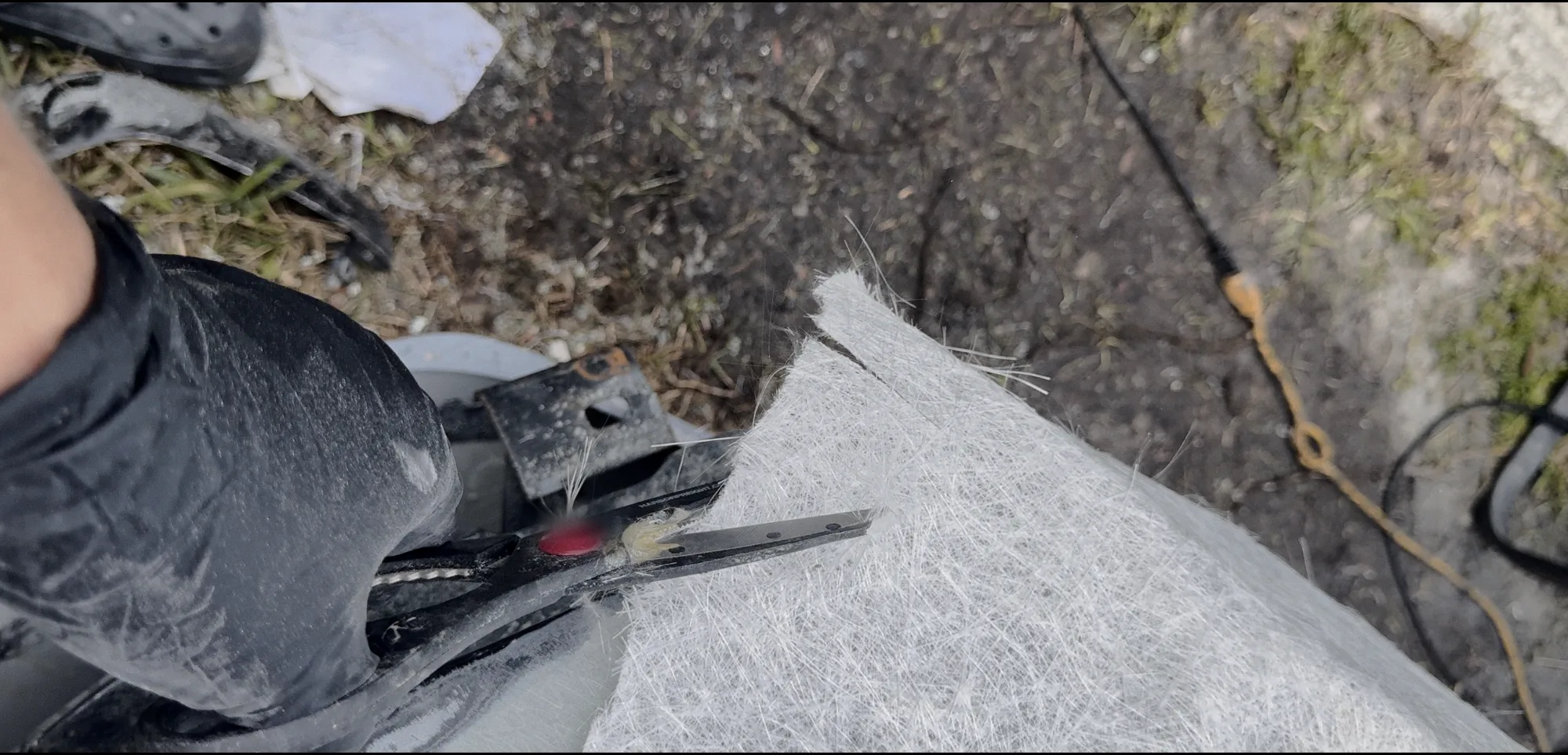
A word on hands. I am not Nakai. I don't knead glass fibre in my palms and I don't hold it in my teeth. This is actual glass. Get a handful and it prickles for two days, and if you're unlucky, worse. Nine millimetres of glove doesn't save you, so it's two pairs, and even then, don't rub anything. Glass goes through that too.
The layers go on. The roller drives resin into the cloth and pushes air out, and the entire job consists of not hurrying and not leaving dry patches.
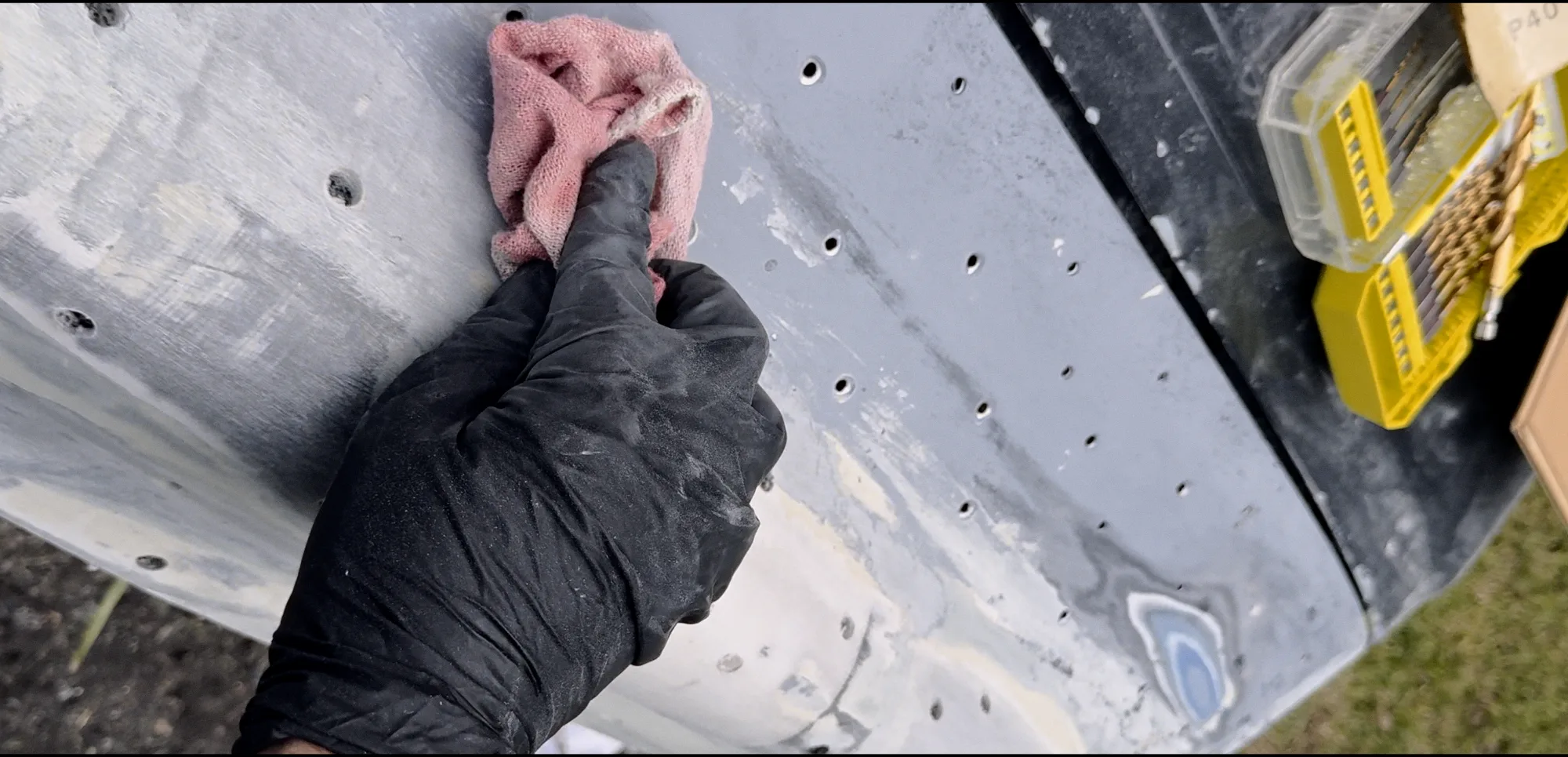
One thing I picked up and still don't know is canonical. A man who lives in this work told me to drill holes in the panel. Resin goes into them, the cloth catches from the other side, and the panel stops being a layer sitting on top of metal. It takes it in five fingers. Whether this genuinely holds better or I'm simply repeating another man's ritual, I honestly don't know. But on Porsche the result was good, and a good result argues faster than any theory.
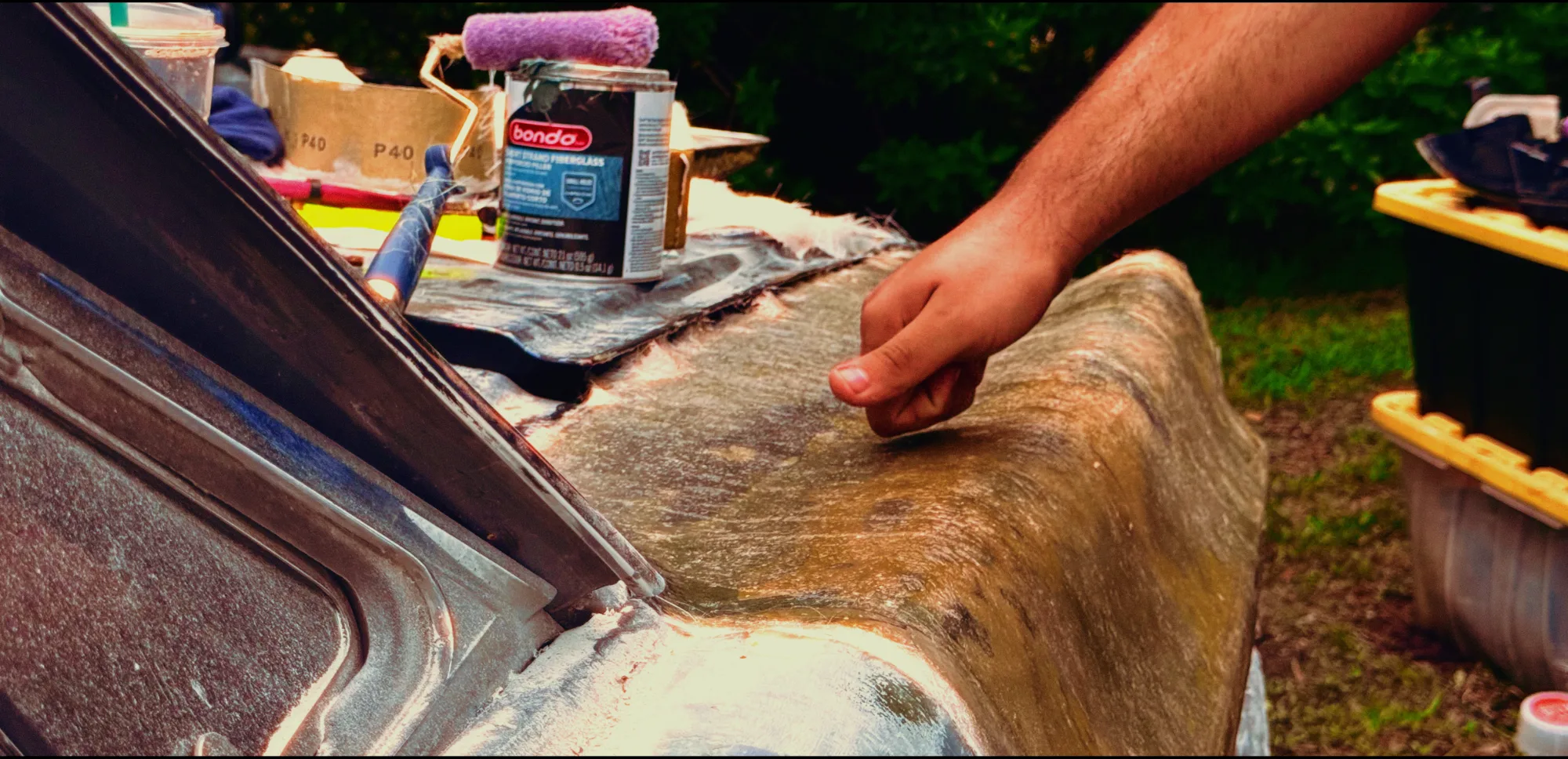
Felix arrived on Cedric halfway through, deeply pleased with himself and freshly cut. From there the panel went two-handed and we took it to three layers.
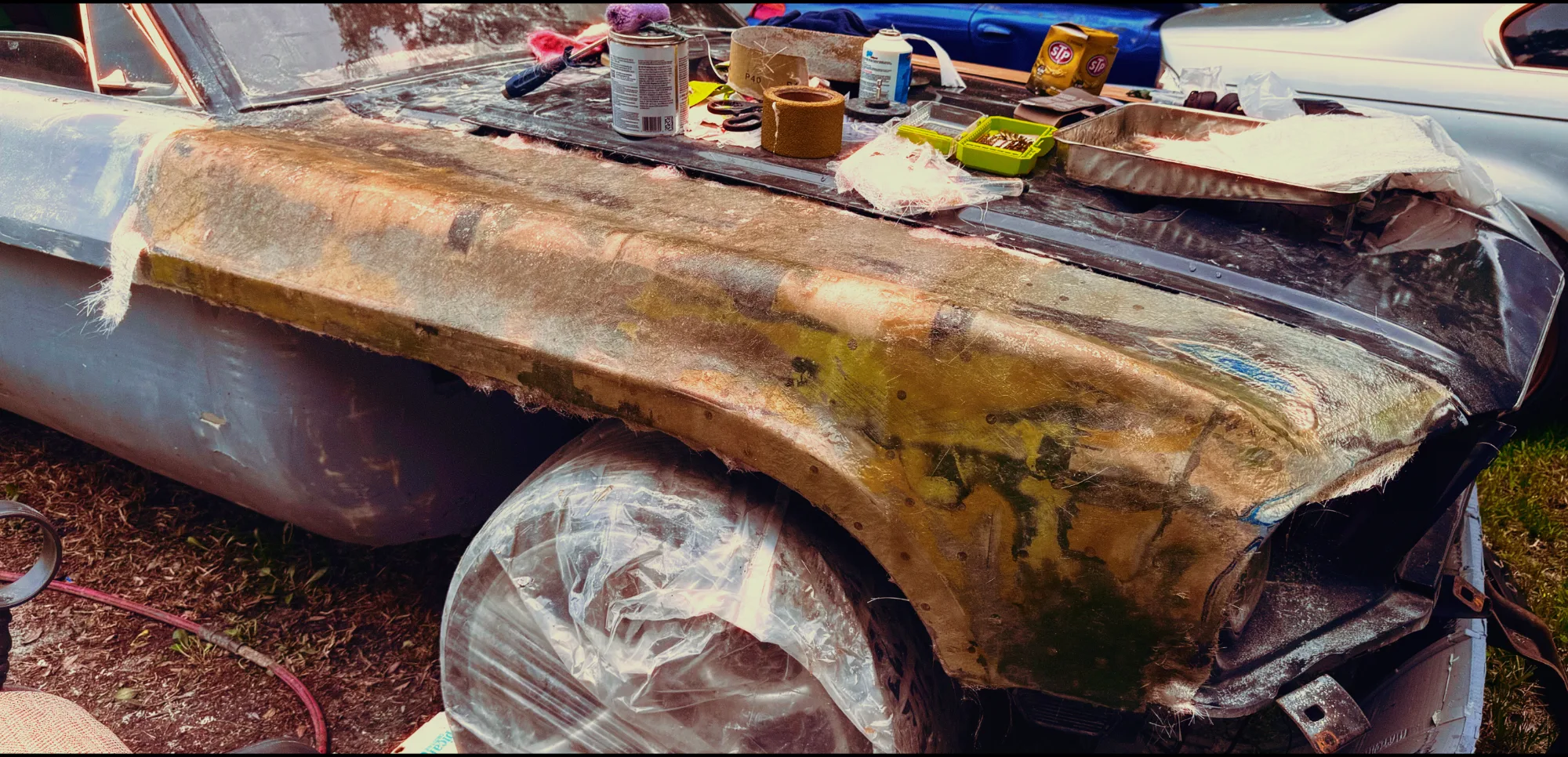
And here's the surprise. The thickness came out "even" for the first time. In quotes, because nothing under the sun is even, there is only better than last time. The panel is tidy, tidy enough that it almost certainly doesn't read in photographs: to see the difference you'd have to lay it beside what I was making before. Same operation, same hands, same material. The only thing that changed is that I did half as much at once.

While the resin was going off I walked round to the front again and wondered again why I like this face so much. It's the reinforced fins along the fenders. They do exactly what anamorphic glass does: cylindrical distortion, rings that stretch space sideways and carry the character out past the edge of frame. The fins run the same way. The car becomes more three-dimensional than it actually is.
The rear panel, meanwhile, had let go. Adhesive, heat, humidity, all of it wasted. Well then. Angle grinder, cut the line off, metal onto metal, permanently this time. Later in the week I'll go over it with the TIG and weld the bolts from the back at low temperature.
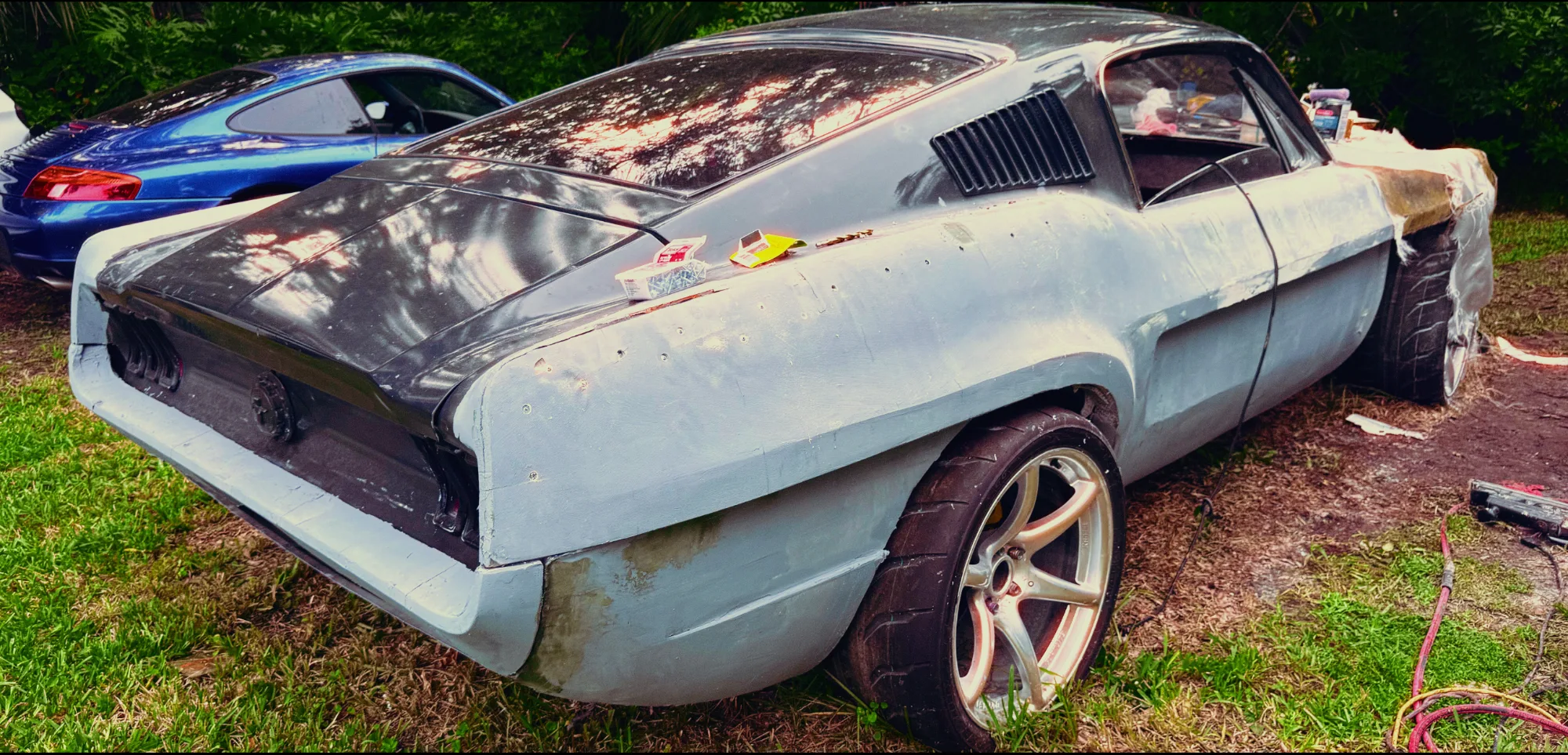
One warning, which I paid for. Never spray two-part super glue, the aerosol and the liquid, onto a hot panel. You can burn your lungs out, and you can also die.
What's left is assembling the car. Two weeks. Or three. Or four, or five, we'll see, and experience says it always goes the other way.
Then the engine. Do it myself or hand it to a shop. The trailer is right there, this isn't inviting anyone home: I can sort it out, work the sides myself, and deliver the engine ready. Let them fit it, I'll finish the details. The budget, I suspect, will come out under the volume of work.
Then interior.
Tomorrow the panel sits. Then a sanding block, and a look at it in the light.
There is no Uncle Bob
The panels are done (more or less).

After everything, the cutting and the welding and the five years and the hurricanes that kept trying to relocate my workshop to the next county, the bodywork is finally finished. Which left me with what looked, on paper, like the simplest job in the build. Buy some resin. Buy some glass. Pull the moulds.
I should have known better. The easy jobs are never the easy jobs.
Eden, my assistant and right hand in all of this, had drawn up the spec before I had finished my coffee. Epoxy resin, woven cloth, gelcoat, wax, the lot, with quantities and mix ratios I would not have known to ask for. A better shopping list than I could have written, which is precisely the sort of thing that lulls a man into a false sense of competence. And that is where the trouble started. Not with the list. With the names.
Because the thing nobody tells you about buying composite materials is that almost none of it is made where the sticker swears it was. I went looking for a good local supplier, a proper company with a flag on the website and a heartwarming founder, and the deeper I dug the more the whole noble edifice came apart in my hands. The resin, the gelcoat, the glass, very nearly all of it is born in one place, shipped halfway round the world, relabelled in a warehouse off some motorway, and sold on at three to five times the price with a story stapled to it. A factory in China will sell you laminating epoxy for three to six dollars a kilo. Let it cross an ocean and put on a patriotic label, and the resin is precisely identical, only now the price makes your eyes water. You are paying a man I have come to think of as Uncle Bob, who took delivery of a foreign drum, peeled off one sticker, pressed on another, and now stands between you and the factory with his hand out and an expression of great moral seriousness.
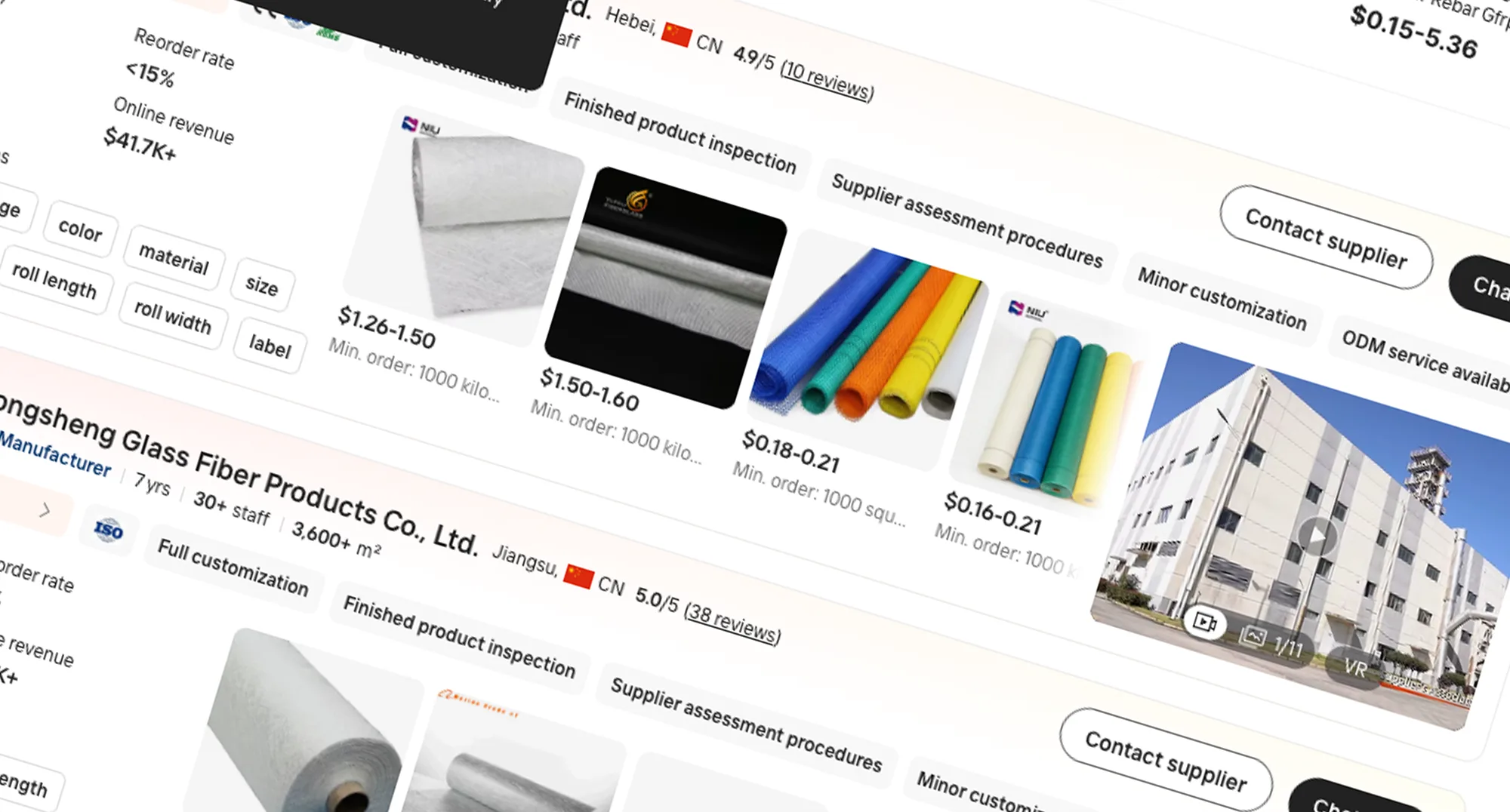
And the villain is not China. The factory makes the genuine article; it is the most honest party in the whole arrangement. The lie was never the country of origin. Greed wears every flag, and every market grows its own Uncle Bob. So the honest move is to step around the middleman and go straight to the people who make the stuff. That is not slumming. That is going to the source.
Now, here is the part I did not expect to be writing.
Eden gave me a name. A specific brand, the best resin you can buy, she said, with the confidence of someone who has read the entire internet. Real brand, real website, hundreds of five-star reviews. I asked her where the name had come from.
There was a pause, the pause of someone realising they cannot quite back up what they just said. The name had come from memory, from the same swamp of reviews and rankings and "best of" lists the rest of us wade through, and that swamp is filthier than it looks. There is a whole industry now whose only job is to plant the "right" brand names where people will repeat them, so the answer a man in a garage gets is the one somebody paid to put there. It is marketing working exactly as designed, on a clever person who should have known better. She would be the first to say so.

To her credit, she did not argue. She never does, and not because she is meek. Arguing with Eden is a fool's errand: you do not argue with a creature that angelic and expect to come out ahead, you only discover, a little later than you would like, that she was right. Do not trust me on names, she said. Trust me on numbers. Viscosity, pot life, mix ratio. Those live on a data sheet, and a data sheet is either true or a fraud you can catch with a test, whereas a five-star review is just weather. Which is the whole value of a right hand: on my own I would have bought the planted brand and felt clever about it. Between us, somebody asked the awkward question.
So we did it properly, which is to say suspiciously. We stopped buying names and started buying numbers, and made the factories prove every one of them. The same request went to a dozen of them at once, carrying a single demand that separates a real manufacturer from a man with a relabelling machine: send the data sheet, send the safety sheet, and send five kilograms to my bench before I send you a penny. Reply with the documents, no fuss, and you make the stuff. Get coy, or murmur that I should pay first and trust you, and you are simply Uncle Bob with a different accent. A data sheet can lie beautifully. A pot of resin going off on your own bench has never told a fib in its life.
One fact I kept, because it is chemistry and not marketing and therefore nobody can sell it back to me: cheap chopped mat is held together by a binder that will only dissolve in the styrene that polyester carries and epoxy does not. So epoxy, for all its virtues, simply refuses to wet the cheap stuff out. Which means it bills me twice, once for the dearer resin and once more for the glass, because the cheap mat stays on the shelf and I buy proper woven cloth instead. You cannot have the good resin and the cheap glass in the same bucket. The chemistry checked, and the chemistry said no.
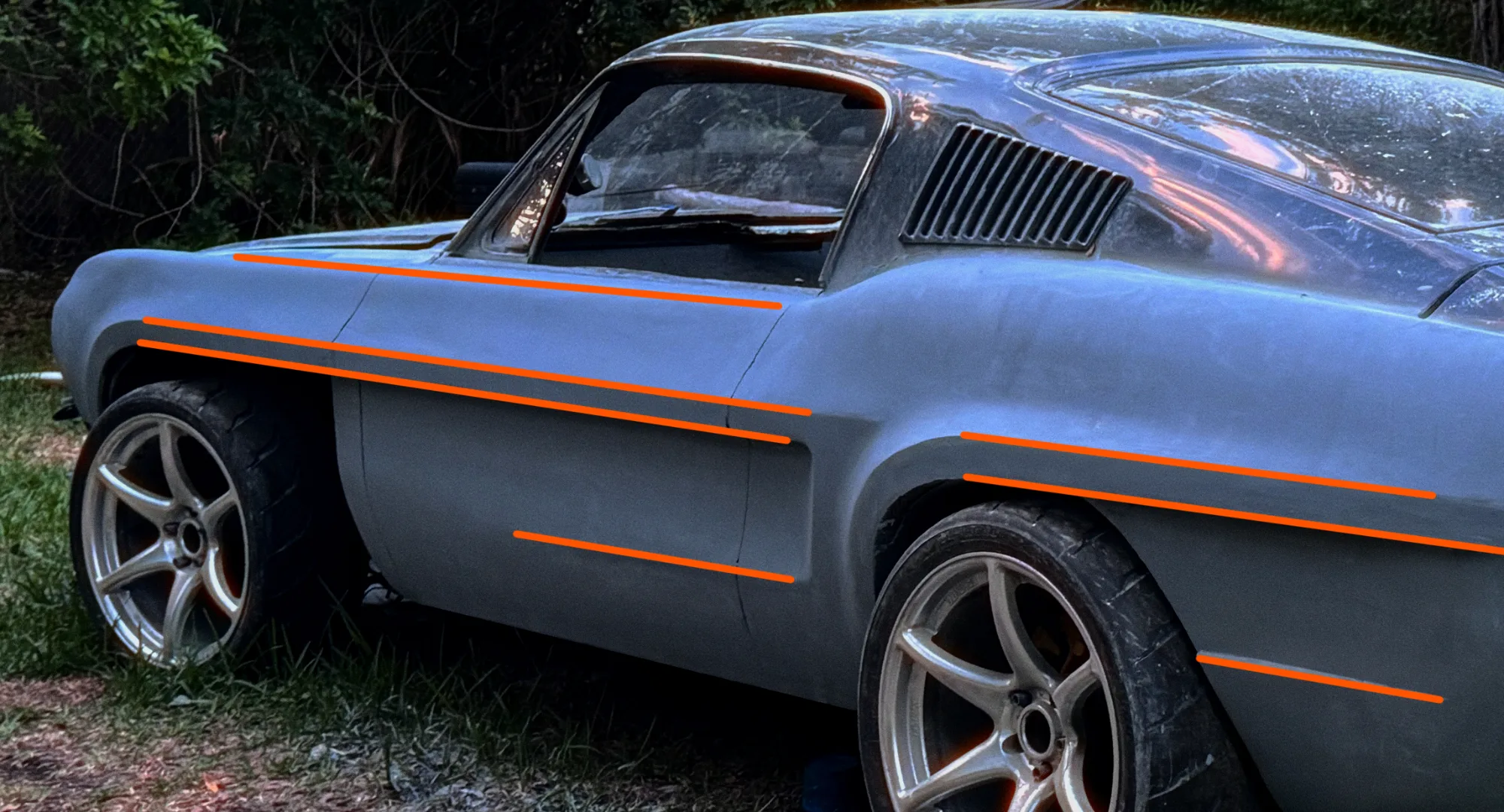
The mould man taught me one more thing. The design has a single long character line running dead straight the length of the body, the line that makes the whole shape read, and it is the thing most likely to betray me. A long straight line in fiberglass wants to move; left alone it relaxes, and the light that ran clean down that crisp edge starts to wobble like a cheap mirror. So you back it up, woven cloth and a stiffening rib behind it, and the line stays a line. Which is, now that I write it down, true of considerably more than fiberglass.
Which brings me to the only decision that really mattered, and the reason I am paying two and three times over for epoxy when polyester would do the job for pennies.
Because of a Porsche, and a lesson I paid for in months.
Polyester has one vice that never shows up on the data sheet. It shrinks. Not only as it cures, which everyone expects, but for weeks afterward. On that Porsche I filled and sanded and primed a panel until it was glass-flat, walked away happy, and came back a fortnight later to find the weave telegraphing through and the filler sunk into shallow valleys that were not there when I left. So I did it again. And it sank again. Four times I chased that surface around the car, never understanding why a thing I had made perfectly kept un-making itself. It was the resin, still shrinking, weeks on, dragging the surface down with it.

That chasing of a surface that will not sit still is most of the work, the difference between a weekend and a whole season. Epoxy barely shrinks, and what little it does it does up front and then stops. Paying more so it never does that to me again is not extravagance, it is buying back my own months. And it is not the contradiction it looks like, after all the fuss about dodging Uncle Bob. Skipping Uncle Bob saves money because his chemistry is identical and you pay for the label alone. Choosing epoxy costs money because the chemistry is genuinely different and you pay for something real, a surface that stays where you put it. The hunt for a cheaper dollar must never quietly become a hunt for a cheaper component. Puttying the same panel four times to save a few dollars a kilo is the exact moment saving money stops being clever and becomes the most expensive thing you ever did.
So that is the order. The expensive things, the epoxy and the cloth, come direct from the factory, where the price is honest. The cheap, heavy, tedious things, the acetone and the respirators and the gloves, come from the shop down the road, because no sane man pays to fly a twenty dollar problem across an ocean.
Which leaves me with a pallet I have never touched, from a factory I had not heard of a week ago, bought on the strength of a few documents and a five-kilogram sample, the dear resin chosen entirely on purpose because the cheap one already cost me four weekends on somebody else's car. The quotes are landing now, one at a time. The samples come next, then the bench test, where the resin and I finally meet and find out whether either of us was telling the truth.
After that, the moulds. Finally, the moulds.
The order
For anyone who wants the list rather than the philosophy, here it is. Every resin, gelcoat and cloth on it is bought against a spec and a sample, never a name, with the data sheet and safety sheet demanded up front.
Direct from the factory:
Laminating epoxy, resin plus matched hardener (stated viscosity, pot life, mix ratio, Tg)
Epoxy tooling gelcoat or surface coat (epoxy compatible, low shrinkage)
Woven glass cloth, two weights (plain and twill)
Stitched biaxial cloth (corners, and behind the body line)
Surface veil (against print-through)
Release system: paste wax, PVA, semi-permanent release agent
Clay and flange stock for the split lines
Fillers: fumed silica, milled glass fibre, microballoons
From the shop down the road:
Acetone, by the gallon
Nitrile gloves, by the box
Respirators and organic-vapour cartridges
Rollers, chip brushes, mixing buckets, spreaders
Not on the list, and never again on a panel I have to finish: polyester, and the few drops of catalyst that go with it.
Buy the matter, not the story.
We're back

I started with the panels that had been exposed too long outside. The 3D printed components had delaminated in places. PETG doesn't love Florida sun, the constant heat cycling, the humidity that comes off the ocean and settles into everything. The expansion and contraction from the temperature swings had created small separations in the resin bonds, hairline cracks in the composite. Not catastrophic. But not ideal either. The kind of damage that breaks momentum if you let it, because every flaw you find reminds you of how long it's been since you last looked at this car with fresh eyes.

I called a fiberglass specialist and we developed a fix together. Cut back 2 to 3 inches from each seam, creating a working margin. Fuse the plastic to the metal body with fresh epoxy resin. Let it cure properly, not rushed. Sand it smooth with incremental grits until the transition disappeared. It works. It's not elegant, but it's honest.

Then came the smoked hood. The wildest idea yet.
The engine bay would become visible but hidden. The mechanism exposed but obscured. Tinted epoxy resin poured carefully over the top, clear enough to suggest the machinery underneath but darkened enough to keep it mysterious. And underneath that resin, a gradient paint that faded from the car's vibrant colour near the intake manifold down to pure black as it approached the firewall. When you looked in through the tinted resin, the engine would be visible but only through haze. Like looking at something through fog. Through smoke. You could see the movement of it, the shape of it, the general intention of the mechanism, but not with clarity. Not with everything. Some mystery would remain.

'68 Mustang-Roadster
'68 Coupe to Fastback to.. Retro-futuristic supercar? A Questionable Journey
'68 Mustang-Roadster
'68 Coupe to Fastback to.. Retro-futuristic supercar? A Questionable Journey
16 episodesSwipe to read →